A home workout planner should start with the space and equipment you actually have. A good plan does not assume a full commercial gym, and it should make progression possible even when equipment is limited. MUNCH+ can use equipment-related assessment inputs and includes a Calisthenics system designed around bodyweight strength and progression.
This guide focuses specifically on home workout planner app UK. It explains the decision framework, what the current MUNCH app supports, common mistakes and the next step without duplicating the broader workout-planning pillar.
Key takeaways
- Home training works best when the plan is designed around real equipment and space instead of copying a gym routine exercise-for-exercise.
- Bodyweight training can still be progressed by changing leverage, range, repetitions, sets, tempo or exercise difficulty when the programme calls for it.
- MUNCH+ includes equipment-aware assessment logic and a Calisthenics workout system; the dedicated Calisthenics guide owns the full system detail.
- A home plan should be easy to start: the fewer setup barriers between you and the session, the better.
- This page owns home-training context, not the broad “free workout app” or “calisthenics plan” intent.
Who this is for
Use this guide when your training location is the main constraint. It is for people working out at home, in a small shared gym or with limited kit. We keep the detailed Calisthenics-system content on its own MUNCH+ cluster to avoid competing for the same search intent.
- People training at home with bodyweight, bands or a small amount of equipment.
- Students or renters who need a plan that works in limited space.
- Users who want the workout choice to reflect equipment access.
- MUNCH+ users considering the Calisthenics system or another equipment-compatible plan.
- Anyone whose plan requires specialised equipment that is not safely available at home.
- People needing supervised rehabilitation or clinical exercise.
- Users looking specifically for live-streamed fitness classes rather than a plan.
- Anyone assuming home workouts must be maximal-intensity to be effective.
Build your plan in MUNCH
Download MUNCH on iOS or Android. Core app tools are free to access, while MUNCH+ unlocks the Performance Center for £1.99 per month. Specialist consultations are separate.
Start a home workout plan with equipment, space and noise constraints
The plan should fit the room before you worry about the perfect exercise list.
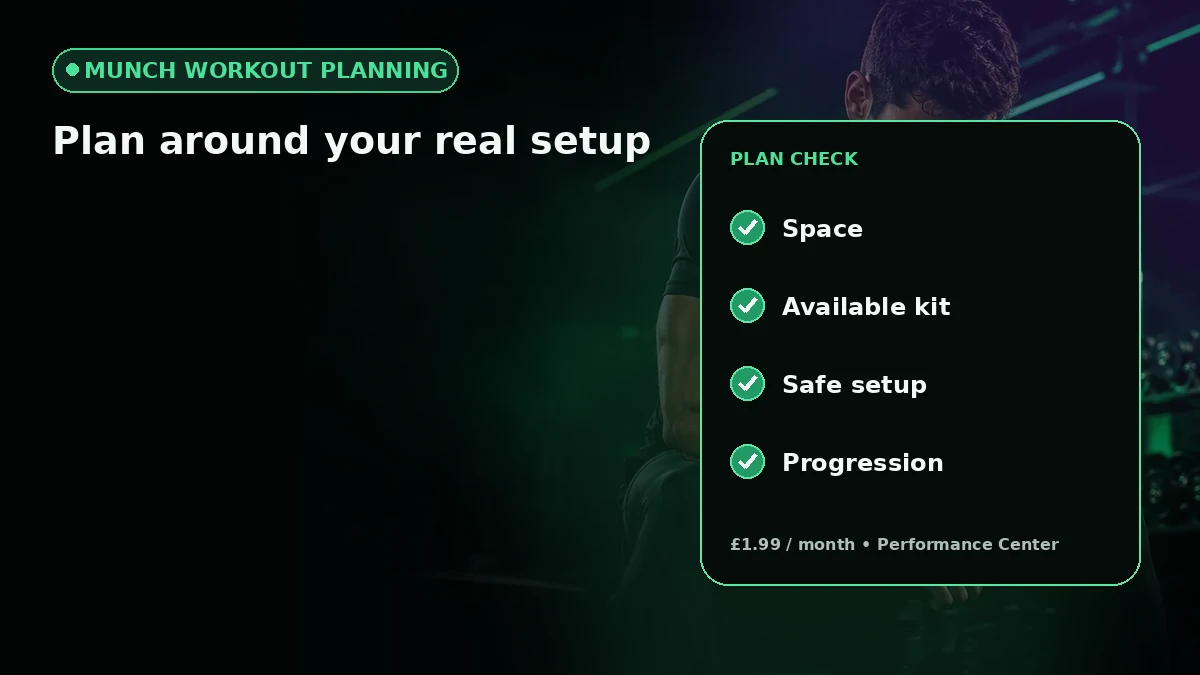
Write down what is actually available: floor space, a mat, resistance bands, dumbbells, a pull-up bar, a bench, or no equipment beyond bodyweight. Then identify practical constraints such as downstairs neighbours, low ceilings or not having a safe anchor point for bands. These details can change exercise selection more than a generic goal label.
A useful home workout planner treats equipment as an input, not an afterthought. If a programme repeatedly asks for equipment you do not own, adherence drops and substitutions become random. Choose or generate the plan for the setup you have now.
- Available floor space
- Stable and safe equipment
- Noise and jumping limits
- Time needed to set up and pack away
- Exercises you can perform with appropriate technique
How MUNCH can organise home and limited-equipment training
The MUNCH+ workout assessment includes equipment context, and the Performance Center offers systems with different equipment demands.
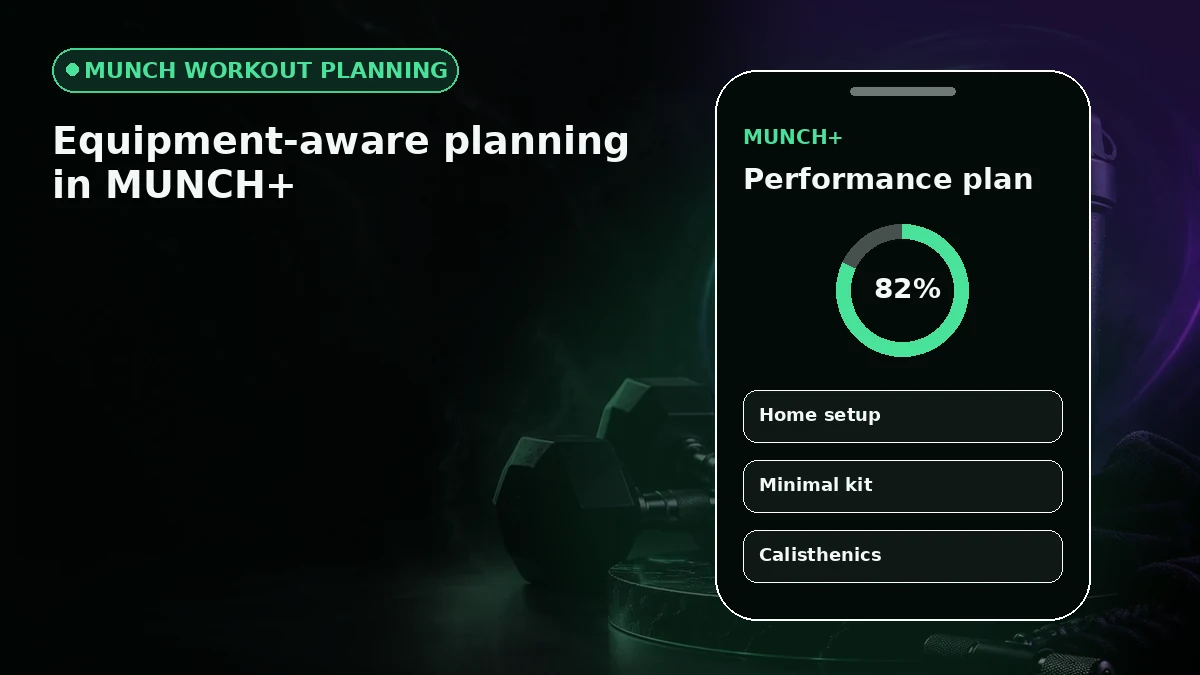
The current MUNCH+ assessment includes an equipment-related input and describes the Calisthenics option as requiring minimal equipment with a bodyweight-strength and progression focus. The app also states that it can choose workout days, equipment needs, exercises and progression from the assessment.
That does not mean every MUNCH workout is a home workout. Different systems have different demands. Review the selected programme before starting and use the dedicated Calisthenics Training Plan guide when you want the full explanation of that system. This home guide stays focused on the location-and-equipment decision.
- 1
List what you can use safely
Include only equipment you actually have regular access to.
- 2
Set the training location honestly
A home setup and a full gym create different exercise options.
- 3
Choose a compatible system
Review whether the recommended workout structure matches the equipment and space.
- 4
Track the progression
Record completed sets, reps and relevant notes so limited equipment does not mean unmeasured training.
How to progress home workouts when you cannot keep adding weight
Progression at home can use more than external load.
When equipment is limited, a programme may progress an exercise by increasing repetitions within a target range, adding a set, using a harder variation, increasing range of motion, slowing a phase of the movement, or reducing assistance. Which option is appropriate depends on the exercise and programme.
Do not make an exercise unstable or technically awkward just to make it “harder.” A progression should remain controlled and suited to your ability. If you cannot progress an exercise safely with the equipment available, that is useful information for the next plan review.
| Progression lever | Example | Useful when | Watch for |
|---|---|---|---|
| Repetitions | More controlled reps in the programmed range | Load is fixed | Technique changing near the end |
| Exercise variation | Move to a more demanding variation | Bodyweight movement has become easy | Jumping too far in difficulty |
| Range or control | Use fuller controlled range where appropriate | Quality is the current limiter | Forcing range that causes pain |
| External load | Add available dumbbell or band resistance | Equipment allows safe loading | Unstable improvised equipment |
Make the home environment support the routine
The advantage of training at home is low travel friction; keep setup friction low too.
Choose a small, repeatable preparation routine: clear the space, put the required equipment nearby, open the planned session and start. If every workout requires moving furniture for 20 minutes, the plan has a hidden cost that will eventually compete with your schedule.
Keep the workout calendar visible and decide in advance what happens when home is unavailable. A backup session should still belong to the programme rather than becoming a random high-intensity video. Consistency is easier when the fallback is planned.
- Store frequently used equipment where setup is fast.
- Use the workout calendar to protect the home-training slot.
- Keep substitutions within the plan when possible.
- Record what equipment or space problems repeatedly interrupt sessions.
Home workout planning approaches compared
| Approach | Strength | Limitation | Best for |
|---|---|---|---|
| Video class library | Easy to follow in real time | May not build a connected progression | Users who enjoy coached sessions |
| Self-written routine | Maximum flexibility | Requires programming knowledge | Experienced home trainee |
| Bodyweight programme | Low equipment barrier | May not match every goal or limitation | People deliberately training calisthenics |
| MUNCH+ plan workflow | Assessment, system selection, schedule and progress in one place | Performance Center is £1.99/month | Users who want plan structure matched to their setup |
Common mistakes to avoid
Copying a commercial-gym plan without checking equipment.
Using unsafe furniture or improvised loads just to reproduce a gym exercise.
Changing to a different random video every session and losing progression.
Assuming bodyweight automatically means beginner-level.
Ignoring repeated joint pain because the exercise uses no external weight.
Action checklist
- 1List equipment and space constraints before selecting the plan.
- 2Choose a weekly home-training schedule you can protect.
- 3Review every exercise for safe setup.
- 4Track completed sets and progression markers.
- 5Use the dedicated Calisthenics guide for full MUNCH+ system details.
- 6Reassess the plan if equipment limitations repeatedly block progression.
Frequently asked questions
Can a home workout planner app work with no gym equipment?
Yes, if the programme is designed for bodyweight or minimal-equipment training. The plan should match the space, exercise level and progression method rather than simply deleting machine exercises from a gym routine. If equipment is limited, progression may use repetitions, controlled variations, range or other programme-defined variables.
Does MUNCH have a home workout option?
MUNCH+ includes equipment-aware workout assessment logic and a Calisthenics system described in the app as minimal-equipment and bodyweight focused. Other workout systems have different demands, so review the selected plan before assuming it is home compatible. MUNCH+ Performance Center access is £1.99 per month.
Is home training only for beginners?
No. Bodyweight and limited-equipment training can be simple or highly demanding depending on exercise selection, leverage, volume and progression. The important point is matching the programme to your current ability and setup. Do not jump to an advanced variation simply because the easier version no longer feels novel.
How do I track progress in home workouts?
Track the variables the programme uses: completed sessions, sets, reps, exercise variation and external load when relevant. Short notes can capture technique or difficulty. Compare like with like across several sessions. A home workout tracker is useful when it records the progression you are actually using, not just calories or time.
Sources and further reading
These sources support the general nutrition, activity or safety context. MUNCH feature details come from the current app implementation.
Related MUNCH guides
Use the pillar for the broad topic, then open the focused guide that matches your next decision.
Build your plan in MUNCH
Download MUNCH on iOS or Android. Core app tools are free to access, while MUNCH+ unlocks the Performance Center for £1.99 per month. Specialist consultations are separate.
About this guide
Written by the MUNCH Editorial Team using the current mobile app implementation, the supplied Search Console query data and the MUNCH SEO content framework. The page is reviewed whenever the feature, pricing or availability changes.