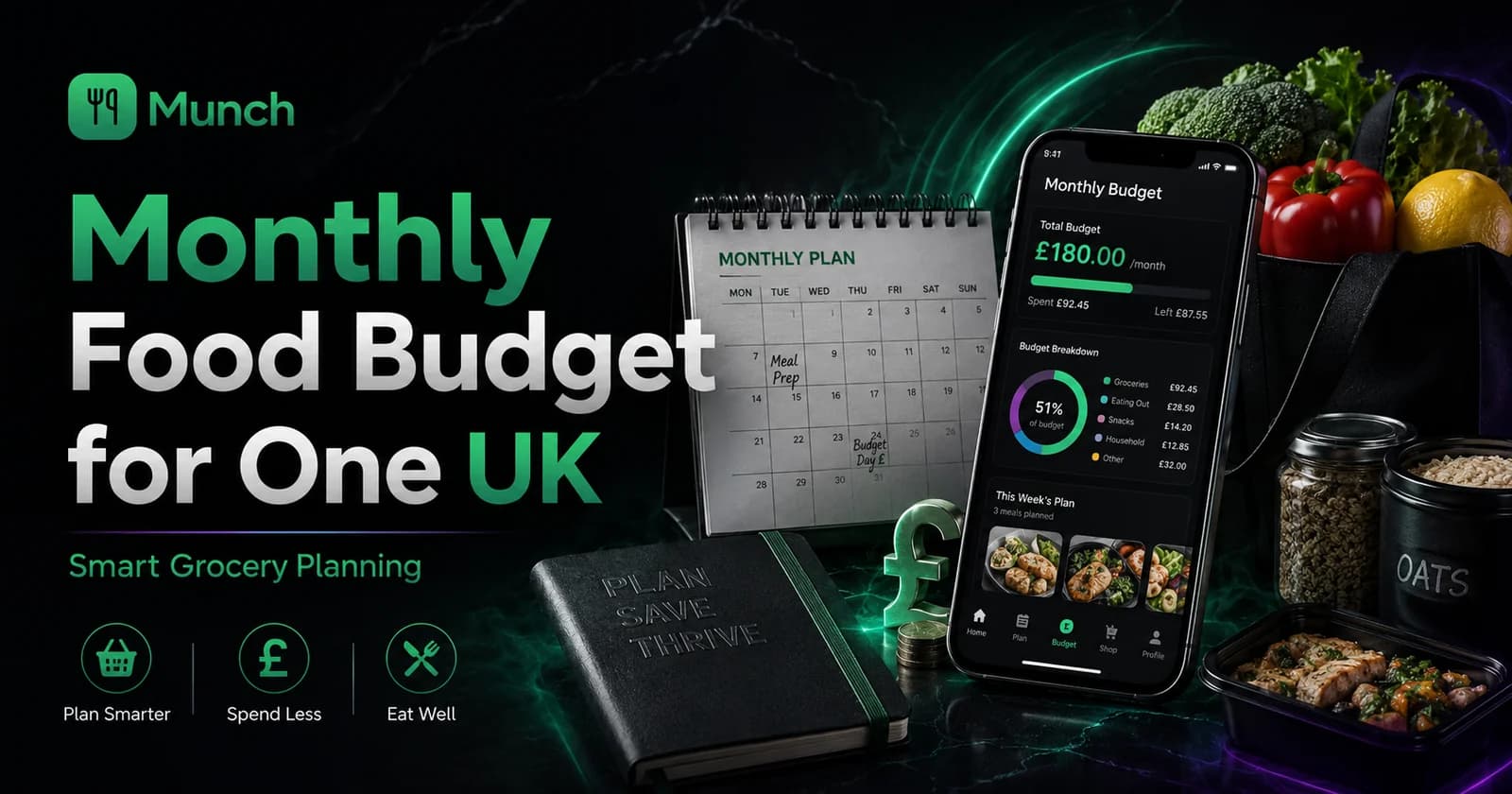
To build a monthly food budget for one UK shopper, start with the amount you can genuinely afford, then divide it into four weekly meal plans plus a small flexible reserve. Plan repeatable breakfasts and lunches, rotate dinners, buy long-life staples strategically and review actual spending after every shop.
Do not copy a single national “average” as though it were your required budget. Food needs, location, dietary requirements, cooking facilities and eating-out habits differ. Your first month is a measured starting point; the next month should be based on what you actually bought, used and wasted.
Key takeaways
- Separate groceries, eating out and household products so the food budget stays understandable.
- Use four weekly plans rather than attempting to predict every meal for an entire month at once.
- Buy long-life staples monthly only when storage and usage make the larger purchase sensible.
- Reserve part of the budget for fresh top-ups and timetable changes instead of spending everything in week one.
- Track waste and unplanned purchases because they explain more than the final total alone.
Who this is for
This method is designed for one-person households and students who want control without turning food into an inflexible spreadsheet.
- People paid monthly who need the food budget to last until the next income date.
- Students or workers whose timetable changes from week to week.
- One-person households that struggle with pack sizes and food waste.
- Anyone who wants to distinguish groceries from takeaways, coffee and household spending.
- Anyone looking for one exact budget that is guaranteed to suit every person in the UK.
- People who need a clinical nutrition plan or medically prescribed dietary restriction.
- Households with several people, where shared staples and portions change the calculation.
- Anyone unwilling to review receipts, waste and unplanned purchases after the first month.
Download MUNCH free and use this feature
Use MUNCH to plan meals, track movement, access AI tools and stay connected to your routine in one app.
Define what your monthly food budget actually includes
A number is useless when different types of spending are mixed together.
Decide whether the budget covers groceries only or also includes takeaways, restaurant meals, coffee, alcohol and household supplies. Mixing these categories hides the reason the total changes. A grocery plan cannot explain a month that includes several unrecorded meals out.
For most people, the clearest setup is to keep core groceries, flexible food spending and non-food household items separate. You can still view the total cost of living, but the meal-planning category remains actionable. When grocery spending rises, you can inspect the foods and quantities rather than blaming a broad “food” total.
| Category | What belongs here | Why separate it |
|---|---|---|
| Core groceries | Ingredients and staple foods used in planned meals | Shows whether the meal plan itself is affordable |
| Fresh top-ups | Milk, bread, fruit, vegetables or other short-life replacements | Prevents week-one spending from pretending to cover the full month |
| Flexible meals | A takeaway, café meal or unexpected social meal if you choose to budget for it | Makes lifestyle spending visible instead of “disappearing” |
| Household products | Cleaning, toiletries and paper products | Stops non-food purchases distorting the grocery result |
| Reserve | A small amount kept for genuine changes or price differences | Reduces the need to abandon the plan after one surprise |
Build the monthly food budget as four weekly systems
Weekly planning is detailed enough to be useful and short enough to react to real life.
- 1
Set the monthly boundary
Choose the maximum amount available for groceries and any separate flexible-food category.
- 2
Protect a reserve first
Do not allocate every pound to planned shops. Keep a small reserve for changed plans, genuine top-ups or price differences.
- 3
Plan week one in detail
Count meals at home, choose recipes and write quantities. Week one gives the first real spending signal.
- 4
Outline weeks two to four
Choose repeating breakfast and lunch formats and rotating dinner themes without locking every product too early.
- 5
Schedule staple and fresh purchases
Buy durable staples when needed, then use smaller fresh top-ups to reduce waste and protect quality.
Do not divide by four and stop thinking
A simple weekly division is a starting limit, not a complete method. One week may include staple purchases while another needs more fresh food. Track the rolling monthly total as well as each individual week.
Solve the problems that make food budgeting harder for one person
Pack size, repetition and waste matter more when no one else shares the ingredients.
One-person households often pay for a packet designed for several servings. The solution is not always to buy the smallest pack. Compare unit price, storage life and how many planned meals can use the product. A larger pack can be sensible when portions can be frozen safely or the ingredient appears repeatedly; otherwise it may increase waste.
Repetition should be intentional rather than accidental. Reuse components while changing the final meal. Cooked rice can support a bowl, stir-fry or side dish. Roasted vegetables can appear in a dinner, wrap and lunch box. This keeps the list efficient without making every plate identical.
- Freeze suitable portions on the day of purchase or cooking instead of waiting until they are almost unusable.
- Choose ingredients that work in several formats rather than several single-use recipe ingredients.
- Use a leftover meal slot before planning an additional dinner.
- Record foods you repeatedly avoid even when they look economical on paper.
- Check storage instructions and food-safety guidance rather than guessing how long an item will remain suitable.
A practical four-week meal and shopping template
Use themes to reduce planning effort while keeping enough variety.
A monthly template does not need thirty unique days. Build a stable base and rotate a few meal themes. Breakfast and lunch can repeat more frequently because they often need to be fast and portable. Dinners can carry most of the variety.
The table shows a planning pattern rather than an exact menu or cost. Replace every example with foods suitable for your needs and cooking facilities. The important part is how staple purchases, fresh top-ups and leftovers are distributed through the month.
| Week | Planning focus | Shopping emphasis | Review question |
|---|---|---|---|
| Week 1 | Establish breakfast, lunch and dinner patterns | Needed staples plus fresh food | Which planned foods were actually convenient? |
| Week 2 | Reuse staples in different meal formats | Fresh top-up and missing ingredients | Did any pack create unnecessary waste? |
| Week 3 | Rotate dinner flavours while keeping core structure | Targeted shop, not a full restart | Are unplanned purchases increasing? |
| Week 4 | Use remaining cupboard and freezer food | Smaller shop and planned leftovers | What should change in next month’s baseline? |
Monthly food budget versus weekly-only budgeting
Both views are useful, but they answer different questions.
| Area | Monthly view | Weekly view |
|---|---|---|
| Main purpose | Protects money across the full pay cycle | Controls the next set of meals and shopping decisions |
| Strength | Shows the rolling total, reserves and category balance | Responds quickly to timetable, stock and fresh-food needs |
| Risk | Can become too abstract without weekly meal detail | Can overspend the month when each week is viewed in isolation |
| Best use | Set boundaries, reserves and category definitions | Build meals, quantities and the actual shopping list |
| Recommended approach | Use as the outer limit | Use as the operating plan inside the monthly limit |
Common mistakes to avoid
Copying an average food figure and assuming it is automatically realistic for your location, needs and routine.
Spending the majority of the budget in week one on products that do not cover later fresh-food needs.
Mixing takeaways, household products and groceries so the category cannot explain what happened.
Buying bulk packs without a storage and portion plan for a one-person household.
Reducing the number after an expensive month without fixing the decisions that caused overspending.
Action checklist
- 1Define whether your limit covers groceries only or other food spending too.
- 2Separate household items and eating out from core groceries.
- 3Protect a flexible reserve before allocating weekly shops.
- 4Plan the current week fully and outline later weeks with meal themes.
- 5Record actual spending, substitutions and extra trips after every shop.
- 6Review food waste, meal completion and remaining staples each week.
Frequently asked questions
What is a realistic monthly food budget for one UK adult?
There is no single correct figure for every UK adult. Location, dietary needs, appetite, cooking facilities, supermarket access and eating-out habits all change the result. Set an affordable starting limit, separate groceries from other food spending and track four real weeks before deciding what is realistic for you.
Should I do one large monthly food shop?
Usually it is safer to combine durable staple purchases with weekly or planned fresh top-ups. One large shop can work for cupboard and freezer items, but buying all short-life food at once may increase waste. Base the frequency on storage, transport, pack sizes and how predictable your schedule is.
How can one person avoid wasting large supermarket packs?
Plan several meals that use the ingredient, freeze suitable portions promptly and compare the usable amount rather than only the unit price. Choose a smaller pack when the larger size will not be used safely. Record repeated waste so the next shopping list changes the pack or ingredient decision.
Is a monthly food budget the same as a monthly meal plan?
No. The budget sets spending boundaries and categories, while the meal plan decides what you will eat and therefore what must be bought. The two work best together: weekly meal plans create the shopping lists, and the monthly view ensures those weekly decisions remain affordable across the whole month.
Sources and further reading
These sources support the general nutrition, activity or safety context. MUNCH feature details come from the current app implementation.
Related MUNCH guides
Use the pillar for the broad topic, then open the focused guide that matches your next decision.
Download MUNCH free and use this feature
Use MUNCH to plan meals, track movement, access AI tools and stay connected to your routine in one app.
About this guide
Written by the MUNCH Editorial Team using the current mobile app implementation, the supplied Search Console query data and the MUNCH SEO content framework. The page is reviewed whenever the feature, pricing or availability changes.