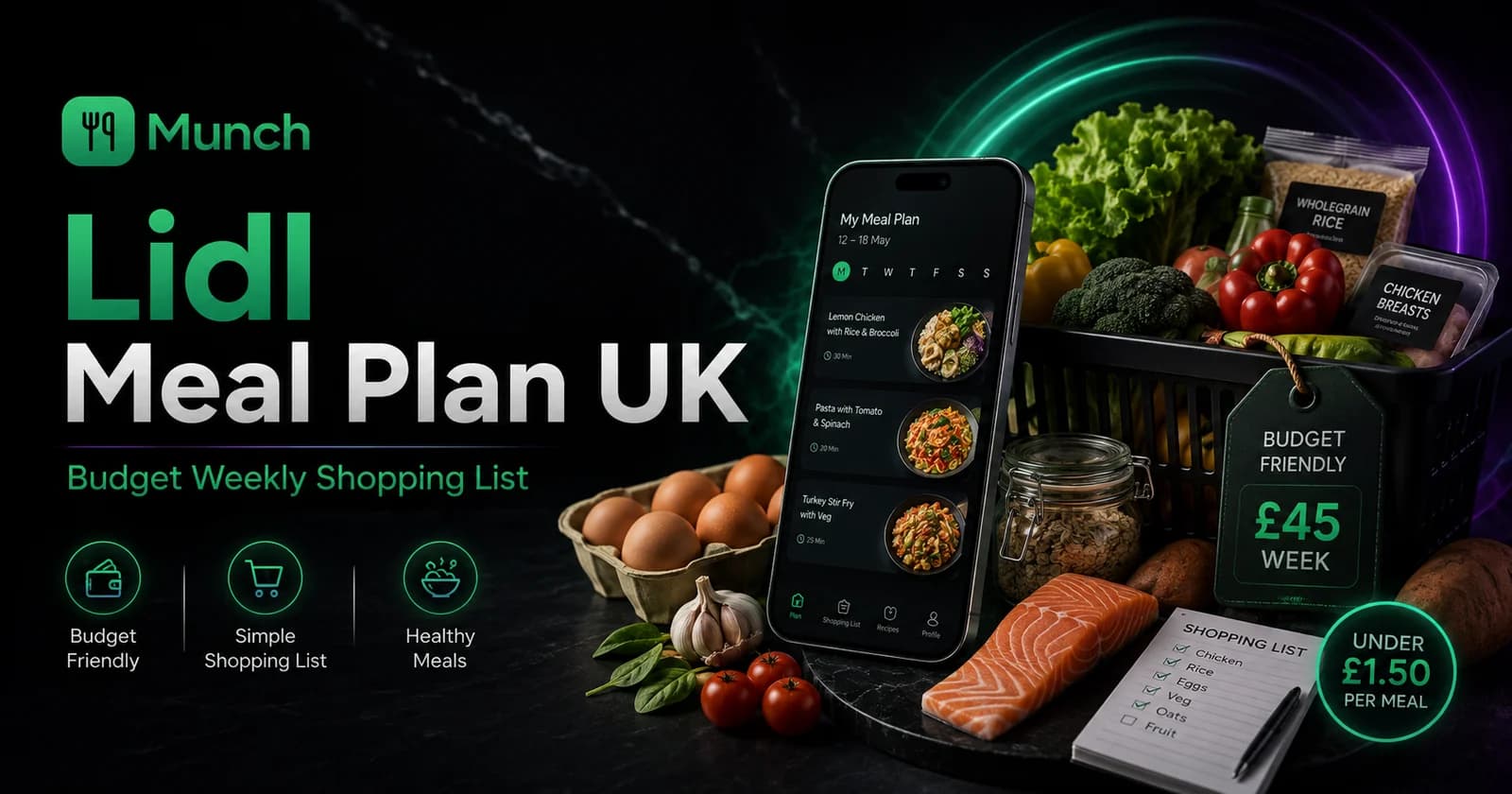
For a useful Lidl meal plan UK shoppers should choose the week’s meals first, reuse a small set of proteins, vegetables and carbohydrate bases, then write quantities for every ingredient. Keep one flexible meal for leftovers and one substitution for any item that is unavailable or unexpectedly expensive.
MUNCH helps keep the meals and grocery list connected, but it does not replace checking current shelf prices, pack sizes, allergens or stock. Use the app to organise the decision; use Lidl’s current product information and labels to confirm the purchase.
Key takeaways
- Plan the number of breakfasts, lunches and dinners you genuinely need before selecting products.
- Reuse ingredients across several meals so the list is shorter and food is less likely to be wasted.
- Compare unit prices and usable quantity, not only the number printed on the front of the pack.
- Prepare substitutions by food role: protein for protein, grain for grain and vegetable for vegetable.
- Keep one leftover or freezer meal so a changed timetable does not ruin the week’s budget.
Who this is for
This approach is designed for students, one-person households and small households that want a repeatable Lidl shopping routine without pretending that every branch carries the same products at the same time.
- People who are happy to repeat breakfasts or lunches and vary dinners.
- Shoppers who want a list based on planned meals rather than impulse purchases.
- Students who need flexible substitutions around lectures, work or social plans.
- Anyone who wants to use cupboard staples and leftovers before buying more food.
- Anyone needing a clinically prescribed diet without professional supervision.
- Shoppers expecting a guaranteed live Lidl price database inside this article.
- People who want seven completely different meals with no ingredient overlap.
- Anyone with allergies who has not checked the current label for every packaged product.
Download MUNCH free and use this feature
Use MUNCH to plan meals, track movement, access AI tools and stay connected to your routine in one app.
Why a Lidl meal plan should start with meals, not offers
A discounted product is only a saving when it fits meals you will cook and eat.
The easiest way to overspend in a discount supermarket is to collect individually appealing products without knowing which meals they belong to. The basket may look inexpensive item by item, yet it can still contain duplicate ingredients, missing essentials and food that expires before it is used. A meal-first plan gives every product a purpose.
Start by checking your real week. Count evenings at home, days when you need a packed lunch and mornings when you have enough time to cook. This prevents the common mistake of planning twenty-one full meals for a week in which several meals will happen elsewhere.
- Core foods: main proteins, carbohydrate bases, vegetables, breakfast staples and essential cooking ingredients.
- Flexible foods: snacks, premium toppings, extra drinks and duplicate convenience products.
- Emergency foods: one freezer or cupboard meal for a late day or changed schedule.
- Existing foods: anything already in your fridge, freezer or cupboard that should be used first.
How to build a seven-day Lidl meal plan step by step
Use a repeatable sequence so the shopping list is calculated from the plan rather than improvised in the aisle.
- 1
Audit what you already have
Check cupboards, fridge and freezer. Add usable ingredients to the plan before buying replacements, and note anything that must be used soon.
- 2
Choose two simple breakfasts
Alternating between two breakfasts keeps costs and preparation manageable while still giving some variety.
- 3
Choose two lunch formats
Use formats that travel well, such as wraps, rice bowls, pasta salads, soup or leftovers, depending on your timetable and storage.
- 4
Choose three or four dinners
Select dinners that share ingredients. A tray of vegetables or cooked grain can support more than one meal without making every dish identical.
- 5
Add a leftover and backup slot
Leave one meal uncommitted for leftovers and keep one low-effort freezer or cupboard option for disruption.
The overlap rule
Aim for each expensive or perishable ingredient to appear in at least two planned meals. Ingredient overlap is one of the simplest ways to make a small basket work harder without eating the exact same dish every day.
Example weekly structure for a smaller Lidl basket
This is a planning pattern, not a fixed prescription or a promise about current prices.
The table below shows how a limited group of ingredients can create several meal formats. Adjust portions, foods and dietary requirements to your own needs. The value comes from the structure: one ingredient can support breakfast, lunch and dinner instead of being purchased for a single recipe.
Do not copy the example blindly. Replace foods that conflict with allergies, intolerances, religious requirements or personal preferences, and verify the current label. The plan should make shopping easier, not force unsuitable food choices.
| Meal slot | Example format | Ingredients reused elsewhere | Planning benefit |
|---|---|---|---|
| Breakfast A | Oats with yoghurt and fruit | Oats and yoghurt can also support snacks | Low preparation and easy quantity control |
| Breakfast B | Eggs on toast with vegetables | Eggs and vegetables can appear in lunches | Uses versatile ingredients |
| Lunch A | Chicken or bean rice bowl | Rice and vegetables can support dinner | Suitable for batch preparation |
| Lunch B | Wrap with protein, salad and sauce | Protein and salad overlap with bowls | Fast to assemble |
| Dinner A | Pasta with tomato base and vegetables | Tomato base can support another dinner | Cupboard-friendly structure |
Turn the plan into a Lidl shopping list that controls quantity
A useful list includes quantities, priorities and substitutes—not only ingredient names.
Write the total quantity required across the week. “Chicken” is too vague; “enough chicken or an equivalent protein for four portions” is a decision. Exact quantities depend on the meals, household and appetite, but the list should still show how many portions each purchase must cover.
When pack sizes differ, compare the unit price and the amount you will actually use. A larger packet may be cheaper per unit but more expensive overall, and it is not a saving when the unused portion is wasted. Frozen and cupboard products can be useful when they reduce spoilage, but they should still fit the meal plan.
- Write portions or quantities next to every ingredient.
- Mark the meals that depend on each high-cost item.
- Compare unit price when packs contain different amounts.
- Choose a smaller pack when the larger one is likely to be wasted.
- Keep optional snacks and premium toppings in a separate section.
Lidl meal plan versus an unplanned weekly shop
The difference is not the supermarket; it is whether each purchase has a role in the week.
| Decision | Planned Lidl shop | Unplanned shop |
|---|---|---|
| Meal coverage | Meals and portions are counted before shopping | Coverage is discovered after the basket is bought |
| Ingredient overlap | Core ingredients support several meals | Products may belong to only one recipe |
| Substitutions | Alternative roles are prepared in advance | Changes are made under time pressure |
| Waste control | Existing food and leftovers are included | Cupboard and fridge stock may be forgotten |
| Budget adjustment | Optional items can be removed first | Essential and optional items are mixed together |
Common mistakes to avoid
Treating every promotional product as a saving even when it does not complete a planned meal.
Planning seven completely different dinners and buying ingredients that appear only once.
Comparing packet prices without checking pack size, unit price or the quantity likely to be used.
Forgetting breakfasts, snacks, drinks or lunches and then making extra midweek purchases.
Relying on an article or old screenshot for current price, stock, ingredients or allergens.
Action checklist
- 1Count the meals that will actually happen at home this week.
- 2Check fridge, freezer and cupboard stock before selecting new meals.
- 3Choose two breakfasts, two lunches, three or four dinners and one flexible meal.
- 4Make expensive or perishable ingredients work in at least two meals.
- 5Write quantities, essential items, substitutes and optional extras.
- 6Check current Lidl product details and labels before paying.
Frequently asked questions
Can MUNCH show a Lidl meal plan UK shoppers can follow?
MUNCH can help you organise meals, recipes and the connected shopping list, but the best plan depends on your household, schedule, preferences and current product availability. Build the week inside the app, then confirm Lidl prices, pack sizes, ingredients and stock through current retailer information and product labels.
How many different meals should I plan for one week?
Most people do not need twenty-one completely different meals. Two breakfast formats, two lunch formats, three or four dinners, leftovers and one backup meal can provide useful variety with much better ingredient overlap. Adjust the pattern around your timetable, dietary needs, storage space and willingness to repeat food.
Is Lidl always the cheapest supermarket for a meal plan?
No supermarket is automatically cheapest for every basket, location or week. The result depends on the exact products, pack sizes, offers, travel and waste. A well-planned Lidl basket can be cost-effective, but compare the foods you genuinely need and verify current prices rather than relying on a general claim.
Should I choose fresh or frozen vegetables for a budget plan?
Use the option that fits the meal, storage and likelihood of being eaten. Frozen vegetables can reduce waste and support quick meals, while fresh vegetables may suit salads or specific textures. Compare usable quantity and avoid buying more than the plan can consume before quality declines.
Sources and further reading
These sources support the general nutrition, activity or safety context. MUNCH feature details come from the current app implementation.
Related MUNCH guides
Use the pillar for the broad topic, then open the focused guide that matches your next decision.
Download MUNCH free and use this feature
Use MUNCH to plan meals, track movement, access AI tools and stay connected to your routine in one app.
About this guide
Written by the MUNCH Editorial Team using the current mobile app implementation, the supplied Search Console query data and the MUNCH SEO content framework. The page is reviewed whenever the feature, pricing or availability changes.