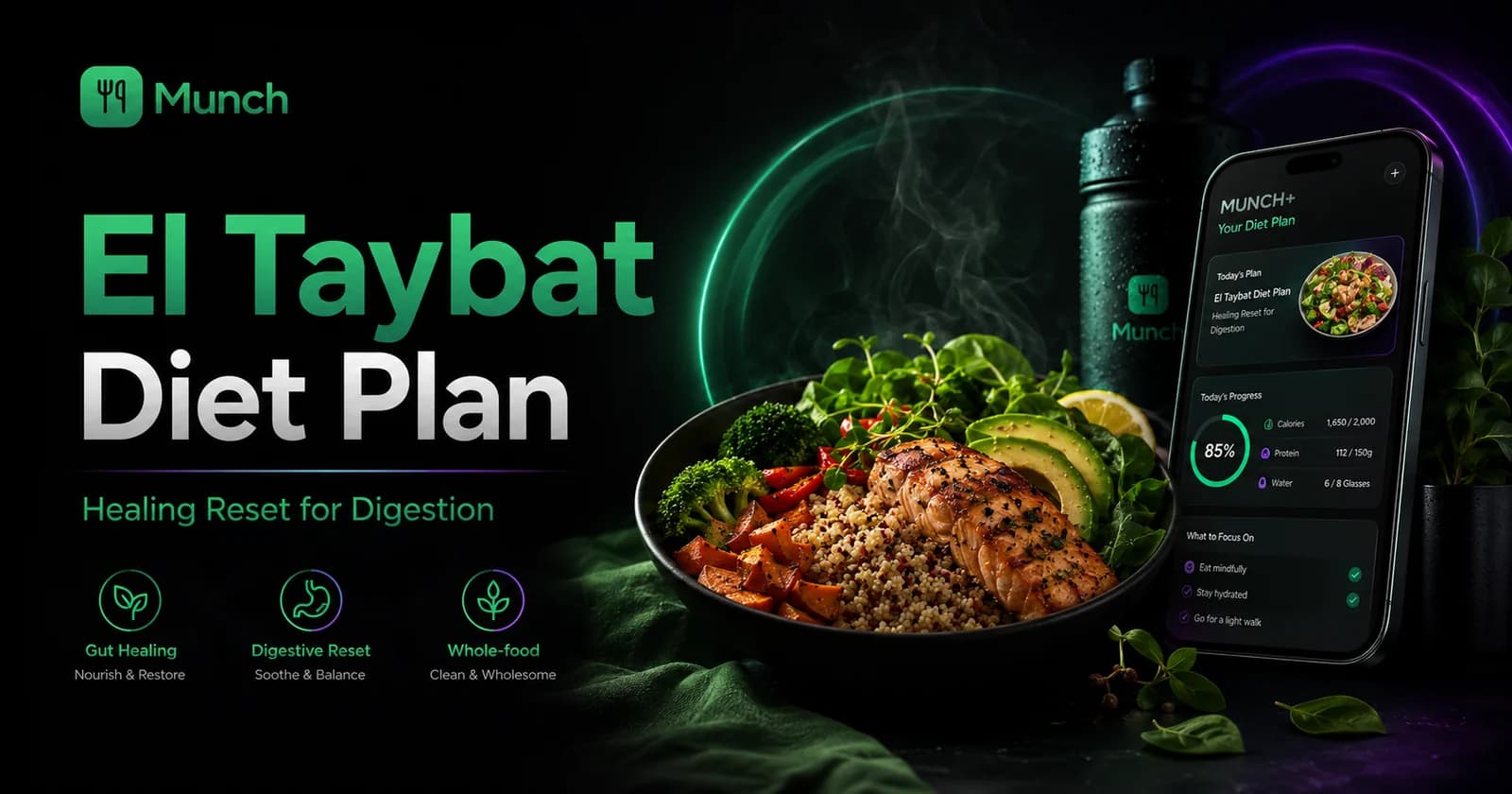
The El Taybat diet plan in MUNCH+—named Healing Reset inside parts of the app—is a structured food-system option for users who want a simpler meal routine with a digestive-comfort focus. The assessment helps organise the plan, while users track meals and how the routine fits daily life.
El Taybat should not be used to self-diagnose IBS, food intolerance or another medical condition. Persistent pain, bleeding, unexplained weight loss, repeated vomiting, fainting or other concerning symptoms require medical advice. Any elimination of major food groups should be handled carefully and, where appropriate, with qualified professional support.
Key takeaways
- El Taybat and Healing Reset refer to the same MUNCH+ diet-system direction.
- The system is a structured meal routine, not a medical diagnosis or guaranteed digestive treatment.
- Simplicity makes it easier to observe which foods, meal sizes or routines feel practical for the individual.
- Removing many foods without a clear reason can create nutritional gaps and make patterns harder to interpret.
- Symptoms and medical concerns should be assessed by a qualified healthcare professional.
Who this is for
El Taybat may suit someone seeking a disciplined, simplified food routine. It is not automatically the right choice for every person reporting bloating or digestive discomfort.
- Users who want a clearer meal structure and fewer random food decisions.
- People prepared to record meals, routine and symptoms carefully without making medical claims.
- Users who prefer whole-food meal formats and consistent preparation patterns.
- People who understand that app guidance does not replace diagnosis or treatment.
- Anyone using the plan to delay assessment of persistent or severe symptoms.
- People planning an extreme elimination diet without professional guidance.
- Anyone with a diagnosed condition whose clinician has provided a different plan.
- Users seeking a guaranteed cure, detox claim or rapid weight-loss promise.
Download MUNCH and open the Performance Center
The app is free to download. MUNCH+ unlocks the Performance Center for £1.99 per month; specialist consultations remain separate.
What El Taybat and Healing Reset mean inside MUNCH+
The name describes a planning framework, not a clinical treatment claim.
El Taybat is the well-known terminology used publicly for this diet direction, while the app also uses the name Healing Reset. Both refer to a structured system that simplifies meals, reduces random variation and encourages the user to observe how a consistent routine fits their digestion and daily schedule.
The word “reset” should be understood as a routine reset, not evidence that the body requires a detox product or that the plan can cure disease. The useful idea is organisational: choose a clear set of suitable meals, eat them consistently, record what happens and avoid changing several variables every day.
Safe interpretation
El Taybat is a structured meal-planning system with a digestive-comfort focus. It does not claim to diagnose, cure or treat a medical condition, and it should not replace advice from a qualified professional.
How an El Taybat meal structure is organised
The plan aims to make ingredients, portions and preparation more predictable.
A simplified plan usually relies on repeatable meal formats rather than a long list of complex recipes. Each meal should have a clear purpose and enough information for the user to prepare it consistently. The exact foods and amounts depend on the generated plan and individual requirements; this article does not prescribe a universal menu.
Predictability can help with observation. When meal timing, preparation and ingredients change constantly, it is difficult to know whether discomfort relates to food, portion size, stress, sleep, speed of eating or another factor. A stable routine does not prove causation, but it produces clearer notes to discuss with a qualified professional if symptoms continue.
- Consistent meal formats that are realistic to prepare.
- Clearly identified ingredients rather than vague “healthy” labels.
- Suitable portions based on the generated plan, appetite and professional advice where relevant.
- A routine for recording meals, timing and comfort without claiming that one note proves a diagnosis.
- A defined review point instead of indefinite restriction.
How to use the El Taybat diet plan responsibly
Follow a controlled process and stop treating restriction as progress when symptoms worsen.
- 1
Complete the MUNCH+ assessment
Describe the goal, routine, preferences and restrictions accurately. Do not hide symptoms or medical advice in order to receive a preferred plan.
- 2
Review every planned food
Check suitability, allergies, religious requirements, preparation and access. The generated plan must still be practical and safe for the individual.
- 3
Keep the routine stable enough to observe
Avoid changing meal timing, ingredients, supplements and training simultaneously when the goal is to understand what feels practical.
- 4
Record meals and context
Note timing, portion changes, sleep, stress, training and symptoms without deciding that one food is definitely responsible from one event.
- 5
Use a defined review point
Review adherence, comfort and nutritional practicality after a meaningful period rather than extending restrictions automatically.
Digestive symptoms need context, not instant food blame
Bloating, discomfort and bowel changes can be real without proving that one ingredient is the cause.
Symptoms can be affected by meal size, eating speed, stress, sleep, hydration, infection, medication, menstrual cycle, training and medical conditions as well as food. A food diary can support a conversation, but it is not a diagnostic test. Removing one food after one uncomfortable meal may create a false conclusion.
Food intolerance and food allergy are not the same. Allergy can involve the immune system and may be serious; intolerance generally follows a different mechanism. A user should not use the El Taybat label to reinterpret a suspected allergic reaction as a routine digestion issue.
| Situation | What the app can help organise | What requires qualified assessment |
|---|---|---|
| Meal routine feels chaotic | Meal formats, ingredients, timing notes and preparation | Clinical nutrition needs or significant symptoms |
| Possible food pattern | Consistent records to discuss with a professional | Diagnosis of intolerance, allergy, IBS or another condition |
| Need to simplify cooking | Repeatable recipes and shopping organisation | Long-term restrictive diet design where nutritional adequacy is uncertain |
| Symptoms are worsening | A record of meals and changes | Medical evaluation and treatment decisions |
El Taybat versus the other MUNCH+ diet systems
Choose by purpose, not by assuming one plan is the “cleanest” or strictest.
El Taybat focuses on a simplified, reset-style routine. High Protein Low Carb focuses on protein-first meals with controlled carbohydrate choices. High Carb High Protein supports users who want protein alongside greater carbohydrate availability for demanding training or mass-gain goals.
These intents should remain separate for SEO and for product clarity. The El Taybat page owns the healing-reset and digestive-comfort planning questions; the other pages own macronutrient and performance-focused questions. Brief comparisons help selection, while detailed guidance belongs on the dedicated sibling page.
El Taybat, High Protein Low Carb or High Carb High Protein?
Select the system that matches the planning problem you are trying to solve.
| System | Best aligned with | Not designed to prove |
|---|---|---|
| El Taybat / Healing Reset | A simplified, repeatable routine and digestive-comfort observation | A diagnosis, cure, detox or universal gut-health protocol |
| High Protein Low Carb | Protein-first meal structure with controlled carbohydrate portions | That carbohydrates are inherently harmful or must be eliminated |
| High Carb High Protein | Fuel and recovery support for greater training demand | That unlimited calories or carbohydrates guarantee muscle gain |
Common mistakes to avoid
Calling the plan a cure, detox or treatment for IBS, intolerance or another condition.
Removing many foods at once and then being unable to identify what changed.
Continuing restriction indefinitely without a review or nutritional rationale.
Ignoring severe, persistent or worsening symptoms because the app plan has not finished.
Confusing food intolerance with food allergy or relying on an old product label.
Action checklist
- 1Complete the MUNCH+ assessment and review the El Taybat system description.
- 2Check every planned food against allergies, medical advice and practical access.
- 3Keep meals consistent enough to observe without creating extreme restriction.
- 4Record meal timing, portions, context and repeated patterns.
- 5Set a clear review point instead of continuing automatically.
- 6Seek qualified help for persistent, severe or concerning symptoms.
Frequently asked questions
What is the El Taybat diet plan in MUNCH+?
El Taybat is the public name for the MUNCH+ Healing Reset diet-system direction. It provides a simplified, structured meal routine with a digestive-comfort focus. The plan is organisational and educational; it does not diagnose a digestive condition, guarantee symptom relief or replace advice from a qualified healthcare professional.
Is El Taybat the same as the Healing Reset plan?
Yes. El Taybat is the terminology used publicly, while Healing Reset appears as the internal app name for the same system direction. The dedicated page can use both names so users understand the connection, but it should describe the purpose accurately and avoid turning “reset” into an unsupported detox or cure claim.
Can the El Taybat diet plan treat IBS or food intolerance?
No app plan can confirm or treat IBS, allergy or food intolerance by itself. A structured diary and simpler routine may help organise information, but diagnosis and treatment require appropriate professional assessment. Seek medical advice for persistent symptoms or red flags, and do not perform extensive food elimination without suitable guidance.
How long should I follow a Healing Reset diet?
There is no universal duration that is safe and appropriate for everyone. The generated plan, individual response and any professional advice should determine the review point. Avoid indefinite restriction. Review whether the routine is practical and nutritionally suitable, and seek qualified support when symptoms persist or food exclusions expand.
Sources and further reading
These sources support the general nutrition, activity or safety context. MUNCH feature details come from the current app implementation.
- NHS overview of irritable bowel syndromeSymptoms, when to seek medical advice and the importance of individual assessment.
- NHS food intolerance guidanceGeneral information on food intolerance, elimination diets and when professional advice is needed.
- NHS Eatwell GuideGeneral UK guidance on balanced food groups and healthy eating patterns.
Related MUNCH guides
Use the pillar for the broad topic, then open the focused guide that matches your next decision.
Download MUNCH and open the Performance Center
The app is free to download. MUNCH+ unlocks the Performance Center for £1.99 per month; specialist consultations remain separate.
About this guide
Written by the MUNCH Editorial Team using the current mobile app implementation, the supplied Search Console query data and the MUNCH SEO content framework. The page is reviewed whenever the feature, pricing or availability changes.