A muscle-gain workout planner should organise repeated resistance-training sessions and make progression visible. The important parts are a programme you can follow, exercise-specific sets and reps, a progression method and enough recovery to repeat quality work. MUNCH+ can organise workout days, exercises and progression inside a selected training system, then record plan progress.
This guide focuses specifically on muscle gain workout planner app UK. It explains the decision framework, what the current MUNCH app supports, common mistakes and the next step without duplicating the broader workout-planning pillar.
Key takeaways
- Muscle gain depends on repeated training and recovery; an app can organise the process but cannot guarantee a result.
- Progressive overload is broader than adding weight every workout. Follow the programme’s progression rules.
- MUNCH workout plans can contain sets, reps, equipment and progression rules, with completed-set and progress tracking in the app.
- Hybrid Training and High Intensity Training are separate MUNCH+ system pages; this guide owns the goal-first muscle-gain planning intent.
- Nutrition matters to muscle development, but this page does not prescribe calorie or macro targets; use appropriate nutrition guidance for individual needs.
Who this is for
This guide is for people searching by outcome: they want a training app that helps organise muscle-building resistance work. It does not duplicate the MUNCH+ Hybrid, High Intensity or diet-system pages. Those pages own the details of each specific system; this one owns the planning framework for a muscle-gain goal.
- Gym users who want a structured resistance-training plan and a record of progression.
- Beginners who need the workout days and exercise order decided before training.
- Intermediate users who want plan completion, sets, reps and notes in one place.
- MUNCH+ users comparing training systems around a muscle-building goal.
- Anyone expecting a guaranteed rate of muscle gain from an app subscription.
- People with injuries or medical conditions requiring individual exercise prescription.
- Users looking for bodybuilding contest preparation or drug-related guidance.
- Anyone who wants only a calorie tracker rather than a training plan.
Build your plan in MUNCH
Download MUNCH on iOS or Android. Core app tools are free to access, while MUNCH+ unlocks the Performance Center for £1.99 per month. Specialist consultations are separate.
What a muscle-gain workout planner needs to organise
The app should make the programme repeatable and measurable, not just give you a new workout every day.
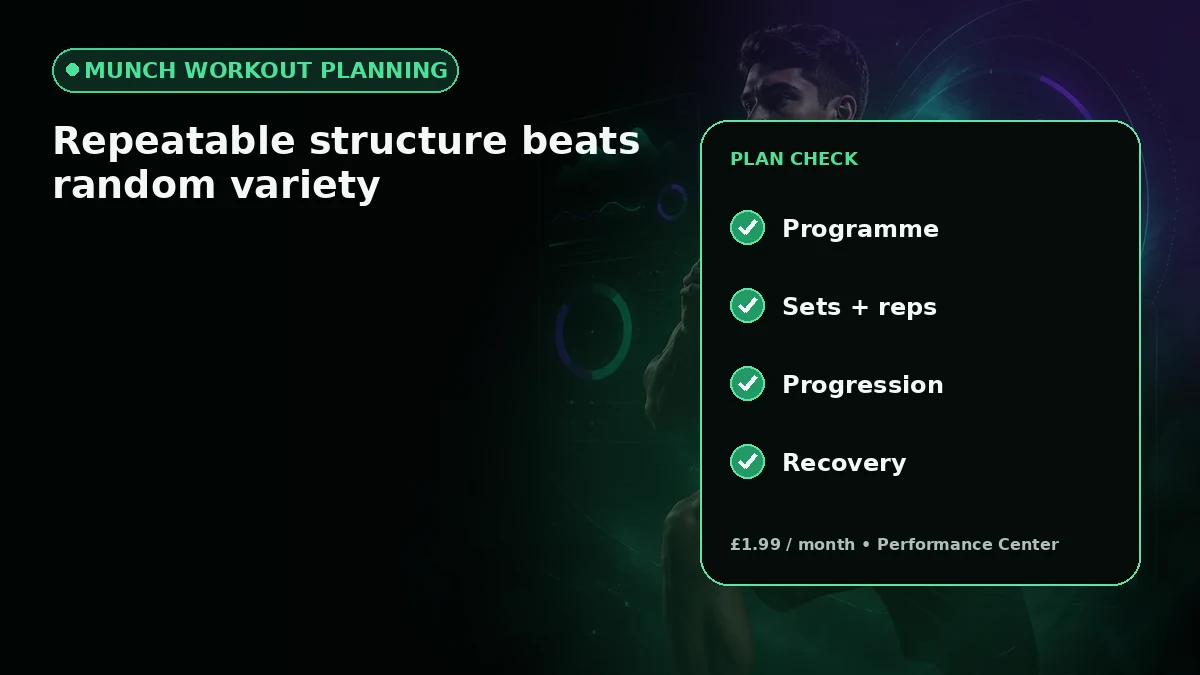
Muscle-building training needs enough repeated exposure to relevant resistance exercises that progression can be evaluated over time. A planner helps by organising which movements belong on which days and preserving the sets, reps and exercise context across sessions. Random variety makes that comparison harder.
The programme should also fit your weekly schedule and equipment. If you repeatedly miss one session because the split does not fit your week, the planner is showing a programming problem worth reviewing. More exercises and more days do not automatically mean a better muscle-gain plan.
- Repeatable weekly structure
- Exercises appropriate to equipment and experience
- Sets and reps that match the programme
- A defined progression rule
- Workout completion and history
- Room for recovery and schedule changes
How MUNCH+ supports structured strength and muscle-focused training
MUNCH+ connects assessment inputs to a selected workout system, plan details and progress tracking.
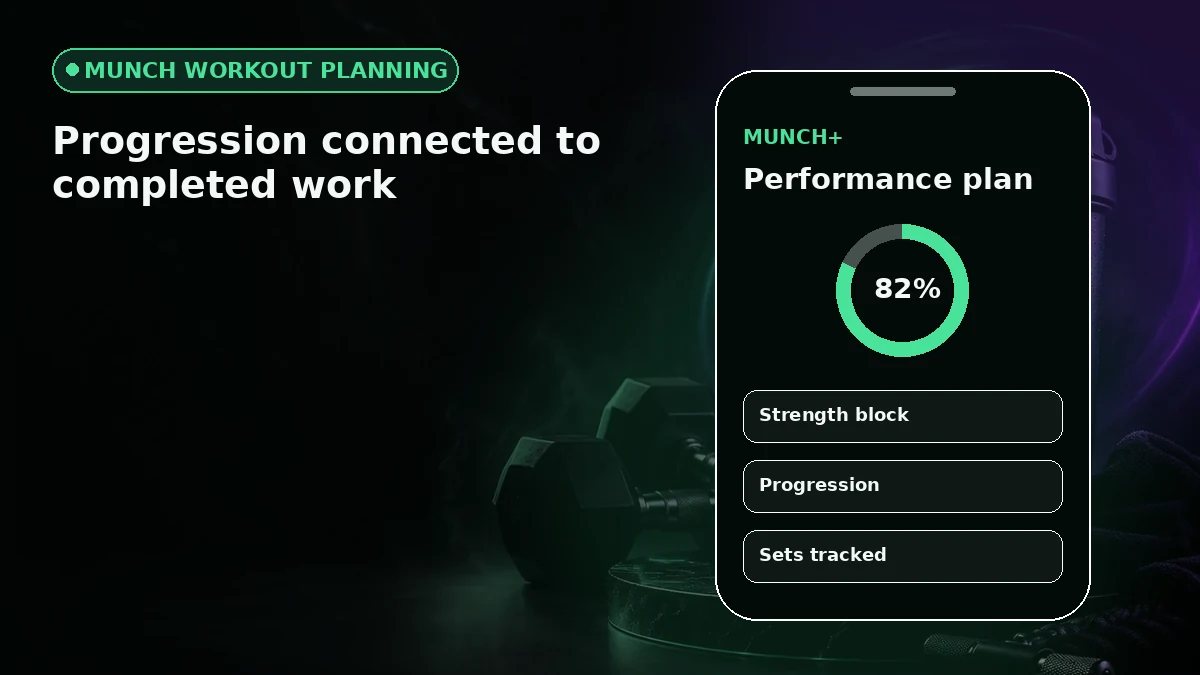
The current MUNCH+ assessment states that it can choose workout days, split, equipment needs, exercises and progression based on the user’s goal. Workout plan data can include sets, reps, equipment and progression rules. During training, completed sets can be tracked, and the Performance plan view can save progress and notes.
MUNCH+ offers different workout systems, including High Intensity Training, Calisthenics and Hybrid Training. Do not treat those names as interchangeable. Open the specific system guide to understand the intended structure before choosing. This article stays at the goal-planning level so it does not compete with those system pages.
- 1
Set the goal and experience level accurately
The plan should reflect current training status rather than an aspirational label.
- 2
Choose a schedule you can repeat
A muscle-gain plan only becomes measurable when the key sessions recur consistently.
- 3
Review exercise and equipment fit
Make sure the programme can be executed with your available setup.
- 4
Follow the progression rules
Use the plan’s logic instead of forcing a load increase every session.
- 5
Track completed work
Record sets and useful notes so later decisions use actual history.
Progressive overload: what the tracker should help you see
Training demand can increase in several ways; the programme decides which change is appropriate.
A simple example is completing more repetitions with the same load inside the programmed rep range before increasing resistance. Other programmes may progress sets, exercise variation, range or another variable. The point is planned progression, not constant novelty.
A tracker is useful because it shows the previous exposure. If you cannot remember whether last week was eight reps or twelve, the next loading decision becomes guesswork. But numbers need context: a heavier set with substantially shorter range or poorer control is not automatically better training.
| Variable | What changes | Why tracking helps | Common mistake |
|---|---|---|---|
| Repetitions | More reps at a given load | Shows capacity within a target range | Adding reps far beyond the programme |
| Load | Resistance increases | Preserves last successful load and reps | Increasing before technique is ready |
| Sets | More work sets where programmed | Makes volume changes visible | Adding volume because one session felt easy |
| Exercise difficulty | Harder variation or setup | Records which version was performed | Comparing different variations as identical |
Plan recovery as part of the training week
A planner is not only for work days; it should prevent the week from becoming a pile of hard sessions.
Resistance training creates a demand that must be recovered from before the next exposure is useful. Sleep, total activity, nutrition, stress and illness can all change how a session feels. The workout planner cannot measure every recovery factor perfectly, but the calendar and notes can expose patterns such as repeatedly poor sessions after a specific scheduling choice.
If performance suddenly drops or pain appears, do not respond automatically by adding more work. Check the context and use appropriate professional advice when symptoms are concerning. An app is an organiser and record, not a medical assessment tool.
- Avoid placing every demanding session back-to-back simply to finish the week.
- Use notes to capture unusual difficulty or recovery problems.
- Do not use soreness as the only measure of workout quality.
- Review several sessions before concluding the programme is not working.
Muscle-gain planning tools compared
| Tool type | Good at | Weak at | Best for |
|---|---|---|---|
| Simple workout log | Fast history of sets, reps and load | May not decide the programme | Experienced lifter with an existing routine |
| Static PDF programme | Clear fixed structure | Tracking and schedule changes are separate | User comfortable logging elsewhere |
| Adaptive/planner app | Connects plan and training history | Quality depends on inputs and programme logic | User who wants decisions organised digitally |
| MUNCH+ Performance Center | Assessment-led system, plan details, progression and progress | £1.99/month and not live coaching | MUNCH user wanting a structured training workflow |
Common mistakes to avoid
Changing exercises constantly so there is no comparable progression history.
Treating a load increase as mandatory every session.
Adding sets or days whenever progress feels slow without checking recovery.
Using soreness as proof that a session was effective.
Ignoring technique changes when comparing numbers.
Treating an app-generated plan as medical advice or a guaranteed muscle-gain result.
Action checklist
- 1Confirm the muscle-gain goal and current experience level.
- 2Choose a weekly schedule that can repeat for the training block.
- 3Review equipment and exercise fit.
- 4Follow the programme’s sets, reps and progression rules.
- 5Log completed sets and short notes.
- 6Review trends across multiple sessions before changing the plan.
- 7Use the specific MUNCH+ system guide when choosing High Intensity, Calisthenics or Hybrid Training.
Frequently asked questions
What should a muscle gain workout planner app track?
A useful muscle-gain planner should keep the programme, exercises, sets, reps, load or variation, session completion and progression context easy to review. The exact metrics depend on the programme. Tracking should help you compare repeated training exposures and make the next decision clearer rather than encouraging constant changes.
Does MUNCH+ include muscle-building workout options?
MUNCH+ Performance Center includes multiple workout systems such as High Intensity Training, Calisthenics and Hybrid Training, and its assessment can use your goal, level, schedule and equipment context. The exact system should be reviewed before selection. MUNCH+ costs £1.99 per month; specialist consultations are separate.
Do I need to add weight every workout to build muscle?
No. Progressive overload can involve load, repetitions, sets, exercise difficulty or other programme-defined variables, and progression does not need to happen every session. Follow the programme’s rules and preserve technique. A tracker is useful because it shows what actually happened in previous sessions instead of relying on memory.
Can a workout planner guarantee muscle gain?
No. An app can organise training, schedule sessions and record progression, but it cannot guarantee a body-composition outcome or a specific rate of muscle gain. Results vary with training consistency, recovery, nutrition, individual response and other factors. Seek qualified guidance for medical, injury or individual nutrition concerns.
Sources and further reading
These sources support the general nutrition, activity or safety context. MUNCH feature details come from the current app implementation.
Related MUNCH guides
Use the pillar for the broad topic, then open the focused guide that matches your next decision.
Build your plan in MUNCH
Download MUNCH on iOS or Android. Core app tools are free to access, while MUNCH+ unlocks the Performance Center for £1.99 per month. Specialist consultations are separate.
About this guide
Written by the MUNCH Editorial Team using the current mobile app implementation, the supplied Search Console query data and the MUNCH SEO content framework. The page is reviewed whenever the feature, pricing or availability changes.