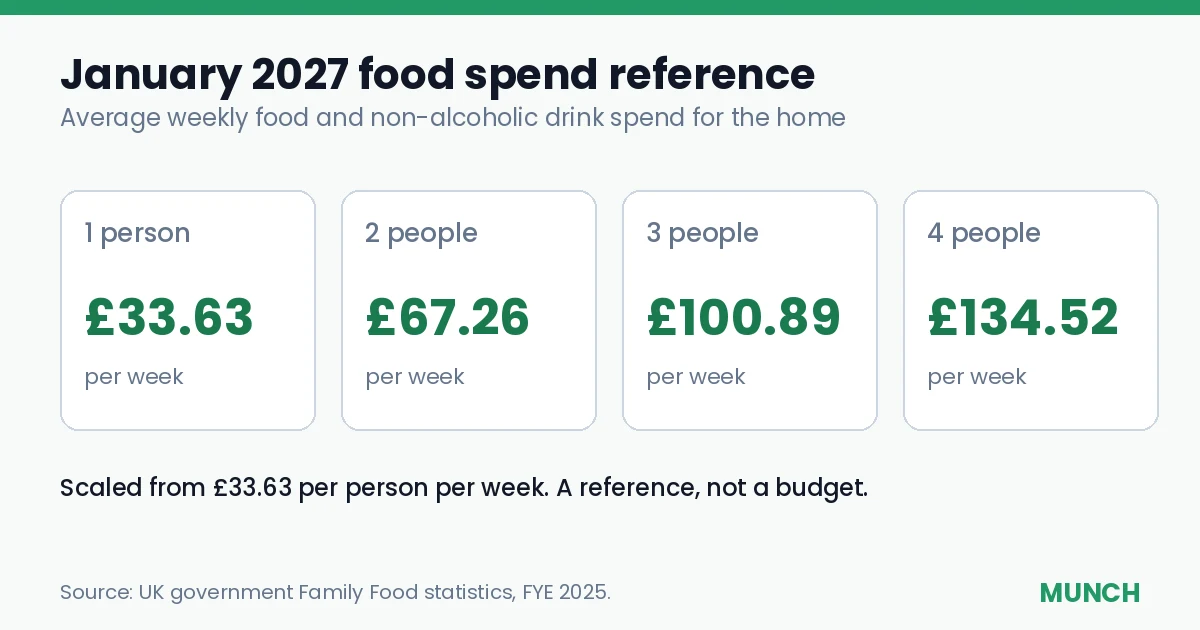
Treat January 2027 as a four-week reset. Start on Monday 4 January, spend week one using up the freezer and cupboards, set a weekly limit from your own receipts, then plan each following week around that number. As a reference point, UK government statistics put average household food and non-alcoholic drink spending for the home at £33.63 per person per week in the financial year to March 2025, which scales to £67.26 for two people and £134.52 for four. Those are averages for all households, not a target.
MUNCH helps you turn the method into an AI-generated custom plan with a connected shopping list. It is a spending and planning method, not a diet, and prices will differ by store and week.
Key takeaways
- Use £33.63 per person per week (the FYE 2025 UK average) as a reference only; your own receipts are a better basis for a budget.
- Week one should use food you already own.
- Store choice matters: Which? found the same 87 items averaged £154.34 at Aldi and £215.87 at Waitrose in October 2026, a gap of £61.53.
- Plan fewer, repeated meals rather than twenty-one different ones.
- Keep one backup meal in the freezer for the week when plans fall apart.
Who this is for
This plan is for anyone who wants to start 2027 in control of food spending after the festive period, without turning January into a diet.
- Households that spent more than usual in December.
- People with leftover ingredients, a full freezer or extra cupboard stock to use first.
- Anyone who wants a fixed weekly limit and a repeatable method.
- Shoppers planning for one person or for a family.
- Anyone looking for a weight-loss or medical diet plan; this is a spending and planning method.
- People who need supervised dietary management for a health condition.
- Shoppers expecting a guaranteed total, since prices differ by store and week.
Download MUNCH free and use this feature
Use MUNCH to plan meals, track movement, access AI tools and stay connected to your routine in one app.
Reference numbers: what UK households actually spend
Official averages give you a sanity check, not a target.
UK government Family Food statistics, built on the ONS Family Spending survey, give a starting point. For the financial year ending March 2025 the average was £33.63 per person per week on food and non-alcoholic drink for eating at home, plus £9.87 per person per week on food and non-alcoholic drink eaten out. Food and non-alcoholic drink for the home took 10.9% of the average household’s spending, and 15.2% for the lowest-income fifth of households.
Those figures are averages across every kind of household and they end in March 2025, so they will not match your local prices today. Use them to sense-check a budget, not to set one.
| Household size | Weekly reference | Four-week reference |
|---|---|---|
| 1 person | £33.63 | £134.52 |
| 2 people | £67.26 | £269.04 |
| 3 people | £100.89 | £403.56 |
| 4 people | £134.52 | £538.08 |
Set a weekly limit from your own spending
Your receipts are a better starting point than a national average.
Pull your last four weeks of grocery receipts or bank entries, leave out takeaways and eating out, and average them. That figure is your real starting point, and the reference table shows whether it sits far above or below the national average. Then choose a limit you can realistically hit, such as a modest step down from your recent average, rather than a drastic cut that collapses by week two.
- Count only groceries bought for home.
- Track eating out and takeaways as a separate line.
- Write the weekly limit at the top of the plan.
- Review it after week two and adjust once, not every day.
The four-week January method
Each week has one job, which keeps the plan simple.
- 1
Week 1, from Monday 4 January 2027: freezer and cupboard first
List everything usable in the freezer, fridge and cupboards, including festive leftovers that are safe to eat or freeze under the product’s storage guidance. Plan meals around them and buy only fresh essentials such as milk, bread, fruit and vegetables.
- 2
Week 2, from Monday 11 January: the first full plan
Plan two breakfasts, two lunches and three or four dinners, set your weekly limit and write the shopping list with quantities.
- 3
Week 3, from Monday 18 January: repeat what worked
Keep the meals the household actually finished, drop the ones that produced waste and adjust quantities to match what was eaten.
- 4
Week 4, from Monday 25 January: prepare February
Restock the staples that ran out, note your real average across the month and set February’s limit from it.
Why week one is different
After the festive period many households have extra food in the freezer and cupboards. A week of shopping from stock lowers that week’s spend and shows you what you already own.
Where you shop matters as much as the plan
Which? found a £61.53 gap between the cheapest and dearest basket in October 2026.
Which? priced the same 87 everyday items at eight supermarkets in October 2026 and published the results on 5 November. The averages ranged from £154.34 at Aldi to £215.87 at Waitrose. Lidl with Lidl Plus was £157.17, Tesco with a Clubcard £181.77, Sainsbury’s with Nectar £182.90 and Asda £183.47.
The basket is an average and not your shop, and travel costs, delivery fees and store access also count. But the gap is a reminder that choosing where to buy the staples can change the total as much as any single meal choice. A plan built for the store you can actually reach beats a plan built for the cheapest store you cannot.
Cutting waste is part of the budget
WRAP’s figures show how much bought food is never eaten.
WRAP’s household food waste figures for 2021 put the cost at about £1,000 a year for a household of four, and found that around 12% of the food bought was thrown away. Potatoes, cooked leftovers and bread were the most wasted foods. Spread evenly, £1,000 a year is roughly £19 a week for four people.
That is why the method starts with the freezer and why every plan includes a leftover slot. Planning portions, freezing what will not be eaten in time and using the oldest item first are cheaper than any discount.
- Plan the number of portions, not only the ingredients.
- Freeze portions you will not eat in time and label them with the date.
- Use the oldest item in the fridge and freezer first.
- Give potatoes, bread and cooked leftovers a planned meal.
A January reset versus shopping as usual
The difference is whether January has a starting inventory, a weekly limit and a review point.
| Decision | Four-week reset | Shopping as usual |
|---|---|---|
| First week | Uses the freezer and cupboards | Buys a full shop on top of existing stock |
| Limit | Set from your own receipts | Discovered after the bank statement |
| Meals | Repeated formats with shared ingredients | Each meal needs its own ingredients |
| Review | Weekly, with one adjustment after week two | None until the end of the month |
Common mistakes to avoid
Treating the £33.63 national average as a budget instead of a reference.
Starting with a full shop before using food already in the freezer and cupboards.
Setting a limit so low that it fails in week two and the whole plan is dropped.
Counting takeaways and eating out inside the grocery limit, which hides the real grocery figure.
Planning twenty-one different meals when a handful of repeated formats would do.
Action checklist
- 1Average your last four weeks of grocery spending.
- 2List the freezer, fridge and cupboard stock before week one.
- 3Choose two breakfasts, two lunches, three or four dinners and a backup meal.
- 4Write the weekly limit at the top of the plan.
- 5Review at the end of each week and adjust once after week two.
- 6Check labels and current prices at your chosen store before paying.
Frequently asked questions
Is £33.63 a week a good food budget?
It is an average from UK government statistics for the year to March 2025, not a recommendation. Prices have moved since then and your household, region and diet will differ, so use it to sense-check your own receipts rather than as a target.
Why start on Monday 4 January?
1 January 2027 falls on a Friday, so starting on Monday 4 January gives you a clean Monday-to-Sunday week and four full weeks to the end of the month.
Is this a diet plan?
No. It is a method for planning and limiting food spending. It makes no claims about weight or health, and anyone who needs dietary advice should speak to a qualified professional.
What if I overspend in week two?
Keep the limit but adjust the plan: add a freezer or cupboard meal, remove optional extras from the next list and review again at the end of the week. One high week does not break a four-week method.
Can MUNCH help with a January reset?
MUNCH builds AI-generated custom plans from your preferences and keeps a shopping list connected to the meals. Use it to organise each week, then check your store’s current prices, pack sizes and labels before you buy.
Sources and further reading
These sources support the general nutrition, activity or safety context. MUNCH feature details come from the current app implementation.
- Family Food FYE 2025 (UK government statistics)Average UK spending on food and non-alcoholic drink per person per week, published 17 September 2026.
- Which? supermarket price comparison, October 2026Average price of an 87-item basket at eight UK supermarkets, published 5 November 2026, including loyalty prices at Lidl, Tesco and Sainsbury’s.
- WRAP: urgent action needed to tackle food waste in our homesHousehold food waste figures for 2021, including the cost to a four-person household.
- NHS Eatwell GuideGeneral UK guidance on balanced food groups and healthy eating patterns.
Related MUNCH guides
Use the pillar for the broad topic, then open the focused guide that matches your next decision.
Download MUNCH free and use this feature
Use MUNCH to plan meals, track movement, access AI tools and stay connected to your routine in one app.
About this guide
Written by the MUNCH Editorial Team using the current mobile app implementation, the supplied Search Console query data and the MUNCH SEO content framework. The page is reviewed whenever the feature, pricing or availability changes.