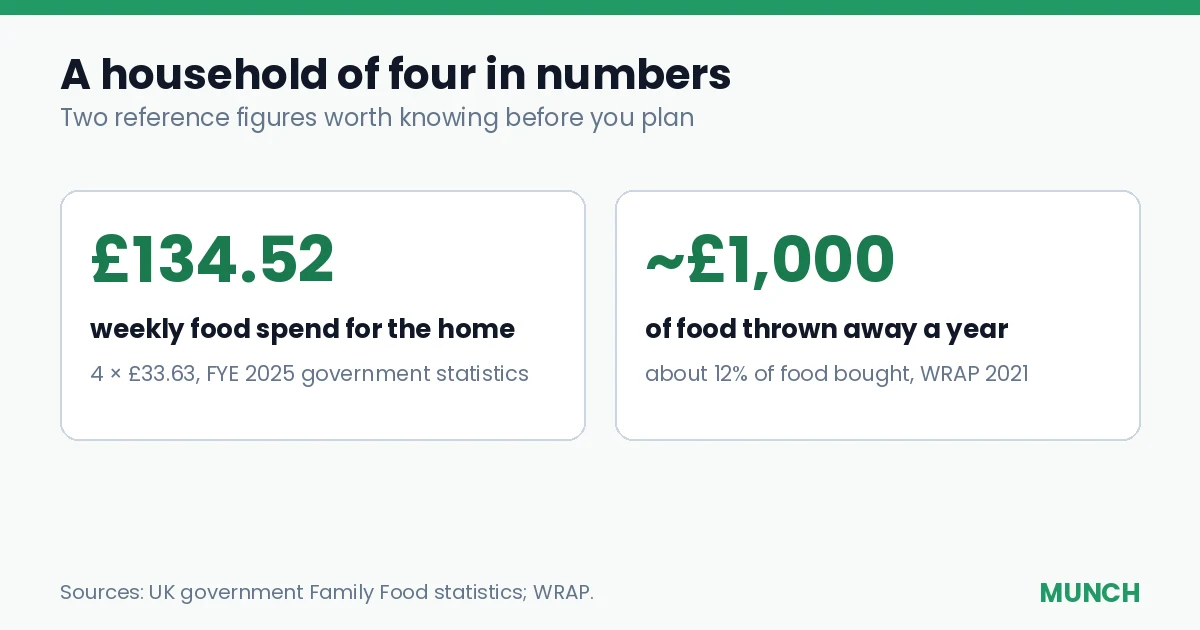
A good family meal planner app does three things: it turns the week’s dinners into one shopping list, it makes it easy to repeat meals the family actually eats, and it helps you cut the food that gets thrown away. UK government statistics put average household spending on food and non-alcoholic drink for the home at £33.63 per person per week (year to March 2025), which scales to £134.52 for four people. WRAP estimates a household of four throws away about £1,000 of food a year.
MUNCH builds AI-generated custom plans from your preferences and keeps a shopping list connected to the meals. It is free to download on iOS and Android; check the store listing for current subscription details.
Key takeaways
- The average UK household spent £33.63 per person per week on food and non-alcoholic drink for the home in the year to March 2025; for four people that is £134.52.
- WRAP estimates a four-person household throws away about £1,000 of food a year, around 12% of what is bought.
- Potatoes, cooked leftovers and bread top WRAP’s list of wasted foods, so give them planned meals.
- Plan a repeatable base meal with different finishes instead of separate meals for each person.
- Check labels yourself: no app replaces the allergen information on the pack.
Who this is for
This guide is for households of three or more who want a repeatable weekly dinner routine and a single shopping list, without cooking a separate meal for each person.
- Parents and carers planning dinners for a family of three to five.
- Households with different tastes that still want to cook one main meal.
- People who want one list for the whole week instead of repeated top-up trips.
- Anyone trying to reduce wasted food without a complicated system.
- Anyone needing a medically supervised or prescribed diet for a child or adult.
- Households with allergies that have not checked every product label directly.
- People expecting an app to guarantee a fixed weekly total.
Download MUNCH free and use this feature
Use MUNCH to plan meals, track movement, access AI tools and stay connected to your routine in one app.
What a family meal planner app needs to do
Six practical tests before you commit to any app.
Most families do not need more recipes; they need fewer decisions at five o’clock. Judge any app by how well it supports that, and check each point in the app itself before relying on it.
- One shopping list for the whole week, built from the meals you chose.
- Meals you can save and repeat, so good weeks come round again.
- The ability to set how many people you are cooking for.
- Room for different tastes, such as a shared base with different finishes.
- Clear ingredient quantities so you can check stock before shopping.
- A way to handle allergies and dietary needs, with the pack label as the final check.
The numbers behind a household of four
Two official figures show where the money goes and where it leaks.
UK government Family Food statistics put average spending on food and non-alcoholic drink for the home at £33.63 per person per week in the financial year ending March 2025. For four people that scales to £134.52 a week, an average across all households rather than a recommendation, and it predates today’s prices.
WRAP’s household food waste figures for 2021 estimate that a household of four throws away about £1,000 of food a year, roughly 12% of the food bought. Spread evenly that is around £19 a week. Reducing waste is therefore part of the budget, not an extra.
| Measure | Figure | Source |
|---|---|---|
| Weekly food and non-alcoholic drink for the home (4 × £33.63) | £134.52 | UK government Family Food statistics, FYE 2025 |
| Four weeks at that average | £538.08 | Calculated from the same figure |
| Food bought but thrown away, per year | About £1,000 (around 12% of food bought) | WRAP, 2021 |
How to plan dinners for four, step by step
A short routine that works with a school-week timetable.
- 1
Ask everyone for two meals they like
A short list from each person gives you a pool of meals the household will actually eat, which matters more than variety for its own sake.
- 2
Sort meals into repeatable bases
Group the meals by base: pasta, rice, potatoes, wraps, traybakes or soups. Bases let several dinners share the same staples.
- 3
Use one base with different finishes
Cook one main component and let people choose the finish: sauce on the side, toppings in bowls or a different filling in the wraps. This handles different tastes without cooking separate meals.
- 4
Put the timetable on the plan
Mark the evenings with clubs, late finishes or no cooking time and give them a batch meal, leftovers or a freezer meal.
- 5
Make one list and shop once
Write the quantities for the whole week, subtract what you already have and shop from a single list. Add the optional items last so they can be dropped.
Plan the leftovers
Cooked leftovers are on WRAP’s list of the most wasted foods. Give them a slot in the plan, such as a wrap night or a packed lunch, so they are eaten rather than found at the back of the fridge.
An example family week, by structure
A pattern to adapt; no prices are quoted.
The table shows how a week for four can reuse ingredients and give each evening a role. Swap meals to suit your family’s diet, religion, allergies and budget, and check the label on every packaged product.
| Day | Dinner approach | Why it works |
|---|---|---|
| Monday | Reheated batch meal from the weekend | Easy start to the week |
| Tuesday | Pasta night with a shared sauce and different toppings | One base, individual finishes |
| Wednesday | Traybake with potatoes and vegetables | Low effort and uses potatoes |
| Thursday | Wraps built from leftovers | Uses cooked leftovers |
| Friday | Family choice, from the saved meals list | Shared decision, fewer arguments |
| Saturday | Slow or batch dish with extra portions | Feeds Sunday and the freezer |
| Sunday | Simple roast-style meal or backup meal | Resets before the week |
Plan around what families waste most
WRAP’s list tells you which foods need a planned meal.
WRAP’s 2021 figures found that UK homes threw away 76kg of food per person, 9kg more than in 2018. Potatoes, cooked leftovers and bread topped the list of wasted foods. That makes them the easiest place to start: give each one a named meal in the plan and buy the quantity that meal needs.
- Potatoes: assign them to a specific traybake, jacket or mash night.
- Bread: freeze half the loaf on the day you buy it.
- Leftovers: schedule a leftover meal and a packed lunch.
- Everything else: check the fridge and freezer before writing the next list.
A planned family week versus deciding at five o’clock
The difference shows up in the shopping list, the waste bin and the evening itself.
| Decision | Planned week | Decided each evening |
|---|---|---|
| Shopping | One list for the week | Repeated top-up trips |
| Ingredients | Shared across several meals | Bought for one meal at a time |
| Different tastes | One base with different finishes | Several separate meals |
| Waste | Leftovers and potatoes have planned meals | Leftovers are discovered late |
Common mistakes to avoid
Planning seven different dinners instead of repeating a few meals the family finishes.
Cooking separate meals for each person instead of one base with different finishes.
Ignoring the timetable, so the busiest evenings have the most demanding meals.
Buying potatoes, bread or fresh vegetables without a planned meal for them.
Relying on an app for allergy information instead of reading the label on every pack.
Action checklist
- 1Collect two liked meals from each person.
- 2Group meals by base and choose the week’s dinners.
- 3Mark the busy evenings and give them a batch, leftover or freezer meal.
- 4Write one list with quantities for the whole week and subtract what you already have.
- 5Give potatoes, bread and cooked leftovers a planned meal.
- 6Check current prices and allergen labels before paying.
Frequently asked questions
Is there a free family meal planner app in the UK?
MUNCH is free to download on iOS and Android. Check the store listing for the current subscription details and what each option includes before you choose.
How do I plan meals for fussy eaters?
Cook one shared base, such as pasta, rice or wraps, and let each person choose the finish: sauce on the side, toppings in bowls or a different filling. That keeps the shopping list short and gives everyone some control.
Can a meal planner app handle allergies?
An app can help you organise meals, but it cannot replace the ingredient and allergen information on the pack. Check the label on every packaged product and follow the advice of a healthcare professional for any diagnosed allergy.
How much food does a typical family waste?
WRAP’s 2021 figures estimate that a household of four throws away about £1,000 of food a year, around 12% of the food it buys. Planning portions and giving leftovers a meal are the simplest ways to reduce it.
Can MUNCH plan dinners for my family?
MUNCH builds AI-generated custom plans from your preferences and keeps a shopping list connected to the meals. Use it to organise the week, then check current prices, pack sizes and labels at your store before you buy.
Sources and further reading
These sources support the general nutrition, activity or safety context. MUNCH feature details come from the current app implementation.
- Family Food FYE 2025 (UK government statistics)Average UK spending on food and non-alcoholic drink per person per week, published 17 September 2026.
- WRAP: urgent action needed to tackle food waste in our homesHousehold food waste figures for 2021, including the cost to a four-person household.
- NHS Eatwell GuideGeneral UK guidance on balanced food groups and healthy eating patterns.
Related MUNCH guides
Use the pillar for the broad topic, then open the focused guide that matches your next decision.
Download MUNCH free and use this feature
Use MUNCH to plan meals, track movement, access AI tools and stay connected to your routine in one app.
About this guide
Written by the MUNCH Editorial Team using the current mobile app implementation, the supplied Search Console query data and the MUNCH SEO content framework. The page is reviewed whenever the feature, pricing or availability changes.